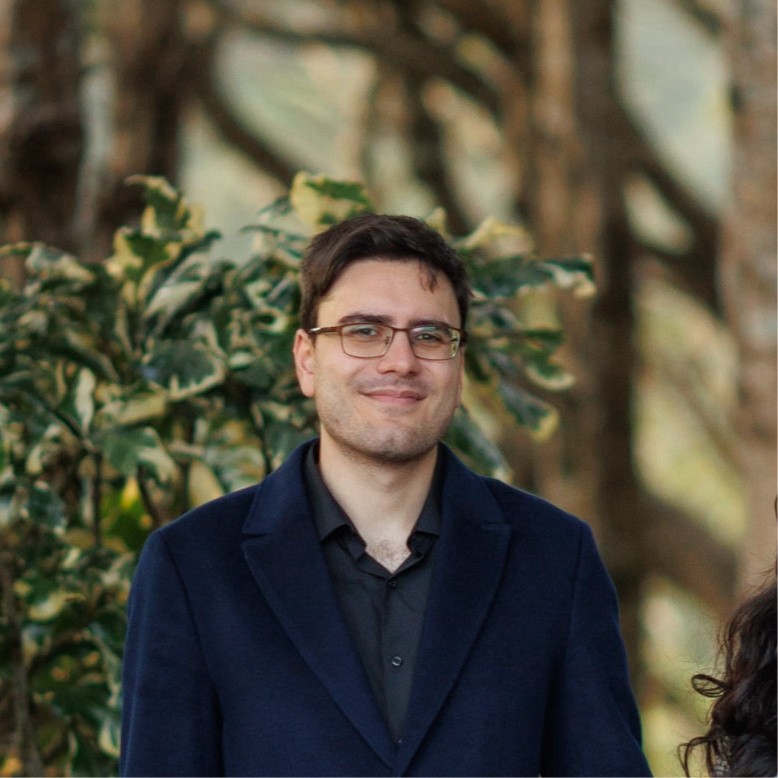
Dr. Kaan Demir
Senior Artificial Intelligence (AI) practitioner with over 7 years of combined experience spanning government, consulting, and academic sectors. I have a deep knowledge of AI from an academic perspective with practical delivery of cloud-native, production-ready solutions in consulting/public sector scenes. Proven in leading client-facing, high-impact AI projects from concept to deployment, driving innovation and responsible governance.
Expertise
- AI Engineering & Fine-Tuning: RLHF, SFT, PPO, DPO, deliberative alignment, guardrails, Chain-of-Thought (CoT) for policy compliance
- LLMs & Advanced AI: AutoGen, LangChain, Agentic AI, RAG, NER, LoRA, Transformers, PyTorch
- Cloud & DevOps: Azure App Services, Databases, Storage, AI Foundry, Infrastructure-as-Code
- MLOps & AI Governance: ISO 42001, Responsible AI frameworks, model lifecycle management
- Data Engineering: ETL/ELT, Star Schema, SQL, pipeline optimisation
- Software Development: Python, Java, R, Pandas, REST APIs, asynchronous programming, front-end and back-end integration (React, TS, Next.JS, Streamlit)
- Leadership & Strategy: Project planning, stakeholder engagement, ROI modeling, Agile/PRINCE2
- Research & Thought Leadership: 10+ publications in internationally recognised AI venues
Experience
AI & Data Engineer
DataSing | 2025 - Current
Lead end-to-end AI PoCs and MVP deliveries spanning frontend, backend, Azure provisioning, DevOps, and MLOps. Built agentic automation that reduced analytic turnaround from months to hours, delivered secure client LLM products in React/TypeScript and Streamlit on Azure, and designed ingestion pipelines with Infrastructure-as-Code and governance controls. Standardised internal frameworks for automated coding agents while owning client engagement, scoping, and senior stakeholder presentations.
Data Analyst (AI & Strategic Projects Lead)
Financial Intelligence Unit, New Zealand Police | 2024 - 2025 (18 Months)
Prototyped LangChain and HuggingFace RAG solutions for legislative analysis, while leading large-scale ETL optimisation across mission-critical pipelines. Designed responsible AI governance frameworks, guided initiatives from business case to proof-of-concept via DataRobot, and regularly briefed governance boards. Developed ROI models for AI investment and brokered the FIU’s high-performance computing partnership with ESR.
Senior Machine-Learning Researcher
Victoria University of Wellington, School of Engineering and Computer Science | 2021 - 2024 (Full Time)
Conducted state-of-the-art research in transformers, attention mechanisms, evolutionary optimisation, and disentangled representation learning for multi-label problems. Led entire research lifecycles—from hypothesis and experimentation to thesis delivery—published extensively in top venues, and contributed as an OpenReview discussant and journal reviewer.
AI & Data Science Researcher (Contract)
Victoria University of Wellington | 2021 - 2024
Delivered applied AI research for multi-agency programmes, including genetic algorithm feature selection for marine biomass, and coordinated outputs across Callaghan Innovation and New Zealand Plant & Food Research.
Head Graduate Teaching Assistant (Contract)
Victoria University of Wellington | 2020 - 2024
Managed and trained a cohort of 30+ tutors, standardised marking and teaching processes, and ensured consistent delivery across large-scale undergraduate papers.
AI & Data Science Researcher (Contract)
Victoria University of Wellington, School of Mathematics & Statistics | 2018 - 2019
Produced statistical and data science analyses, implemented experimental methodologies, and supported research outputs across cross-disciplinary projects.
Education
PhD in Computer Science & Artificial Intelligence
Victoria University of Wellington | 2021 - 2024
Thesis: Evolutionary Representation Learning of Structured Multi-label Data
Honours in Computer Science & Artificial Intelligence
Victoria University of Wellington | 2020 - 2021
Bachelor of Science in Computer Science & Artificial Intelligence
Victoria University of Wellington | 2017 - 2019
Selected Publications
- K. Demir, B. H. Nguyen, B. Xue and M. Zhang, “Multi-Label Black-Box Attacks via Evolutionary Structured Many-Objective Adversarial Perturbations,” in IEEE Transactions on Evolutionary Computation, 2025.
- K. Demir, B. H. Nguyen, B. Xue and M. Zhang, “Dual Sparse Structured Subspaces and Graph Regularisation for Particle Swarm Optimisation-Based Multi-Label Feature Selection,” in IEEE Computational Intelligence Magazine, 2024.
- K. Demir, B. H. Nguyen, B. Xue and M. Zhang, “Co-operative Co-evolutionary Many-objective Embedded Multi-label Feature Selection with Decomposition-based PSO,” in Proceedings of the Genetic and Evolutionary Computation Conference (GECCO ‘23), 2023.
Research Highlights
My research pairs theoretical guarantees with production-grade AI engineering, building trustworthy systems for high-stakes environments.
Evolutionary Adversarial Training for Multi-Label Security (TEVC 2025)
Multi-label models carry real security risk when malicious actors tamper with co-occurring labels. I developed a CMA-ES driven adversarial training framework that operates in tabulated domains, crafting structured yet concealable perturbations without needing access to the target model. The many-objective formulation balances attack success (81–100% in evaluation), robustness, and stealth.
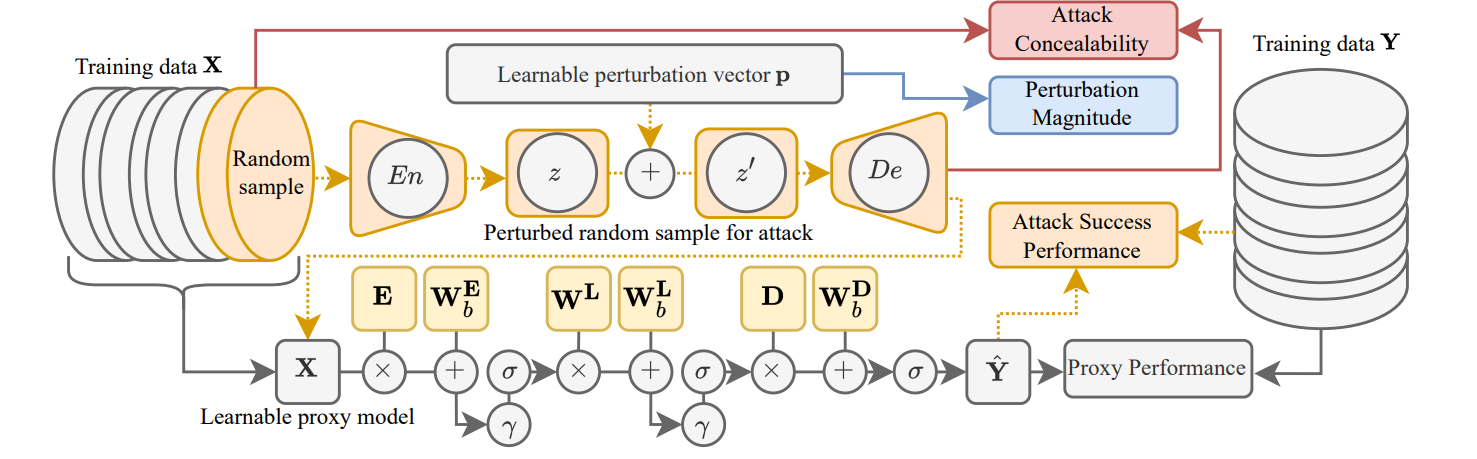
CMA-ES orchestrated adversarial training pipeline across proxy and target multi-label models.
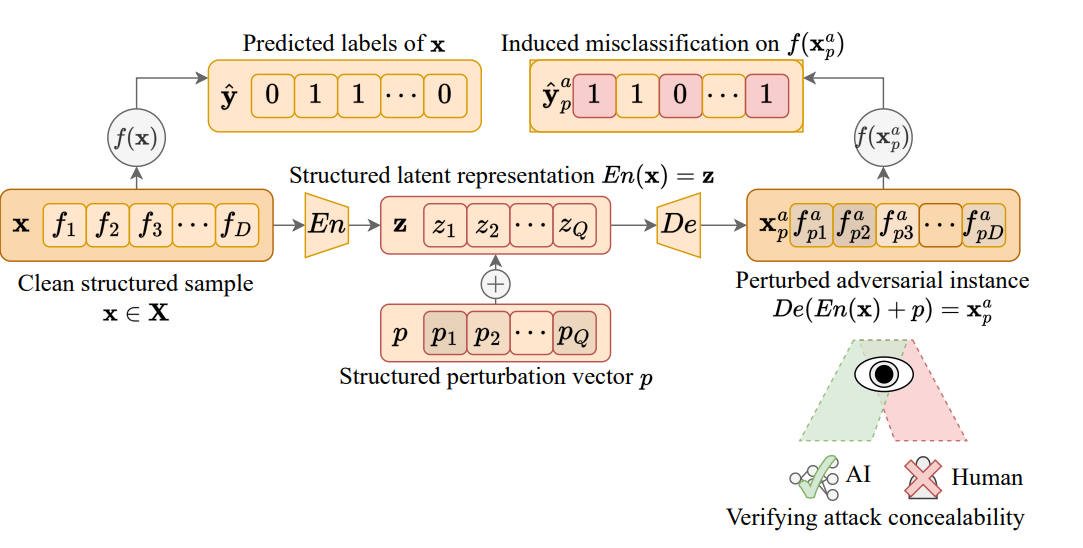
Visual analysis of structured adversarial examples demonstrating concealability across correlated labels.
Consistent Lebesgue Measure Multi-Label Learner (CLML)
Surrogate losses often undermine multi-label consistency. CLML maximises a Lebesgue hypervolume to align simultaneously with conflicting loss functions, delivering a provably consistent learner that still runs on lightweight feed-forward architectures. The approach outperforms graph-enhanced and perturbation-heavy baselines, showing that principled measure design can eclipse brute-force model complexity.
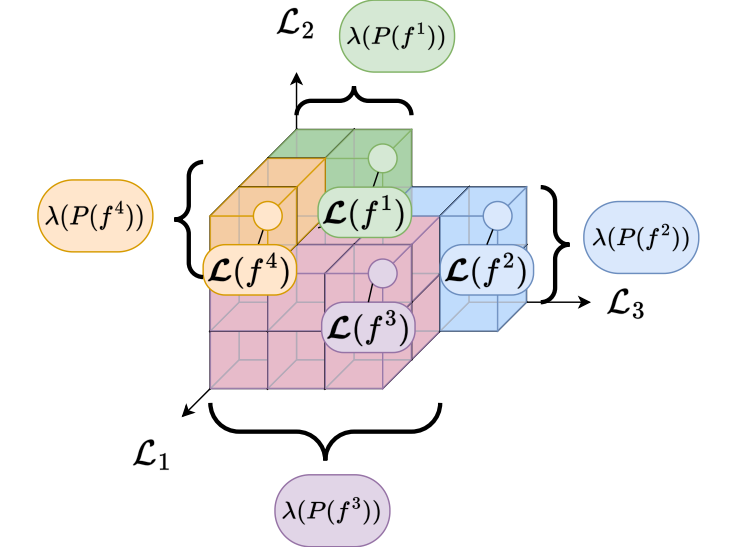
Geometric interpretation of the Lebesgue measure maximisation that underpins CLML.
Excerpts from the Consistency Proof
The key result links hypervolume maximisation to convergence towards Bayes predictors across three loss families:
Pareto dominance ensures every non-Bayes solution is strictly outperformed along at least one loss surface:
These theorems anchor the empirical findings and give decision-makers confidence that performance gains stem from sound statistical guarantees.